
What Time Do Safaris Start & How Long Do They Last in Sharjah? Complete Timing Guide
One of the first things people want to know before booking a desert safari in Sharjah is simple: what time does it start, and when will I be back? It sounds like a basic question, but the answer actually shapes your entire experience. The timing you choose affects the temperature, the light, the activities available, and the overall mood of the safari. Get it right and it can be the highlight of your trip.
This guide covers the timing for every type of desert safari in Sharjah — morning, evening, and overnight — so you know exactly what to expect before you book.
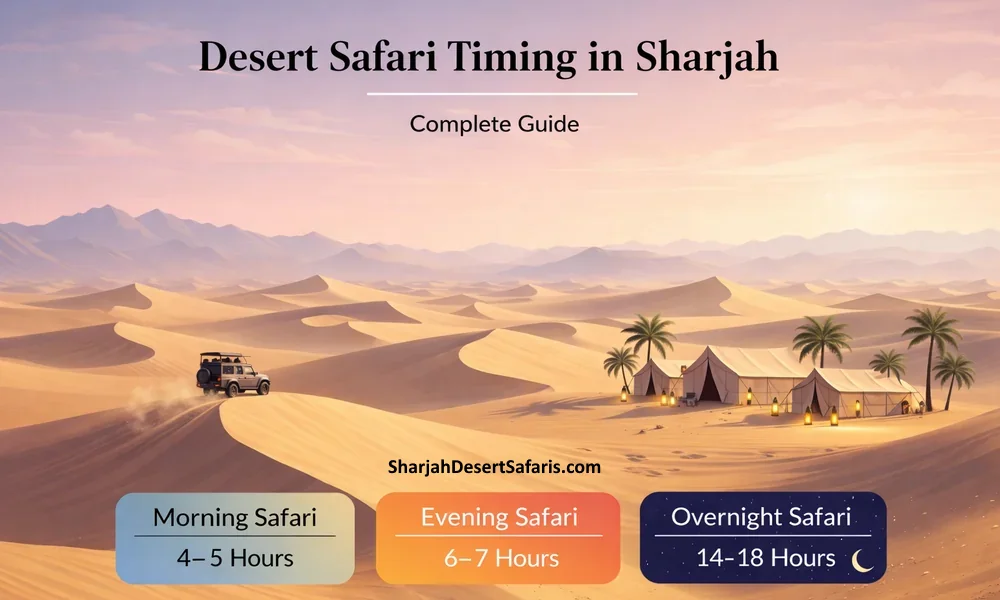
Quick Overview: Sharjah Desert Safari Timings
| Safari Type | Pickup Time | Return Time | Duration |
|---|---|---|---|
| Morning Desert Safari | 7:00 AM – 8:00 AM | 11:00 AM – 12:00 PM | 4–5 hours |
| Evening Desert Safari | 3:00 PM – 4:00 PM | 9:00 PM – 10:00 PM | 6–7 hours |
| Overnight Desert Safari | 3:00 PM – 4:00 PM | 7:00 AM – 8:00 AM (next day) | 16–17 hours |
These are standard timings and can vary slightly depending on the season, your pickup location, and which package you book. In summer months, evening pickup times may be pushed slightly later to avoid the peak afternoon heat.
Morning Desert Safari Timing
The morning safari is the quieter, more peaceful option. Pickup from your home or hotel in Sharjah typically happens between 7:00 AM and 8:00 AM, with the drive to the desert taking around 45 minutes to an hour depending on your location. You arrive just as the desert is warming up and the light is at its most beautiful — golden, soft, and perfect for photography.
The morning safari lasts around 4 to 5 hours, with a return drop-off between 11:00 AM and 12:00 PM. This makes it an easy half-day activity that leaves the rest of your day completely free.
What Happens During the Morning Safari
- Sunrise or early morning dune bashing in a 4×4 Land Cruiser
- Sandboarding on the red dunes
- Camel riding at the camp
- Breakfast picnic with Arabic coffee, tea, and light refreshments
- Photography time on the dunes
The morning is also the coolest part of the day in the desert, which makes it the preferred choice during summer months (May to September) when afternoon temperatures can be brutal. If you’re visiting in summer and want to experience the dunes actively rather than just sitting at a camp, morning is the timing to go for.
Evening Desert Safari Timing
The evening safari is by far the most popular option and what most people picture when they think of a desert safari experience. Pickup from your location happens between 3:00 PM and 4:00 PM, timing the arrival at the desert perfectly with the late afternoon sun. The whole experience wraps up and you’re back home between 9:00 PM and 10:00 PM — making it a full evening out rather than just a short excursion.
The total duration is around 6 to 7 hours, and it packs in more than any other safari option.
How the Evening Safari Timing Breaks Down
- 3:00–4:00 PM — Pickup from home or hotel
- 4:00–5:00 PM — Drive to the Lahbab red sand desert
- 5:00–5:45 PM — Dune bashing in the 4×4
- 5:45–6:30 PM — Sandboarding, camel riding, quad biking, photos
- 6:30–7:00 PM — Sunset viewing (one of the best moments of the trip)
- 7:00–9:00 PM — Camp dinner, belly dancing, tanoura show, fire show
- 9:00–10:00 PM — Drop-off back to your location
The sunset is genuinely one of the highlights. Watching the sun go down over the red dunes from the top of a sand hill, with nothing around you but open desert, is the kind of moment that people talk about long after their trip. The timing is built into the safari schedule specifically to make sure you don’t miss it.
Overnight Desert Safari Timing
The overnight safari follows the same evening timing for the first half — pickup between 3:00 PM and 4:00 PM, dune bashing, sunset, dinner, and entertainment. But instead of heading home after dinner, you stay at the desert camp for the night and return the following morning.
Return drop-off is typically between 7:00 AM and 8:00 AM the next day, after a light breakfast at the camp. The total experience runs for around 16 to 17 hours.
What the Overnight Adds
- Sleeping in a traditional Bedouin-style tent under the stars
- Stargazing in the open desert away from city light pollution
- The eerie, peaceful silence of the desert at night
- Sunrise over the dunes the following morning
- Breakfast at the camp before heading back
The overnight safari is particularly popular with visitors who want to experience the desert beyond the tourist highlights — the silence at 2:00 AM when the camp is asleep and the sky above is full of stars is something you simply can’t get from an evening safari alone.
Which Timing is Right for You?
The best timing depends on a few things — when you’re travelling, what you want to get out of the experience, and who you’re going with. Here’s a simple way to think about it:
| You Should Choose… | If… |
|---|---|
| Morning Safari | You’re visiting in summer, want a half-day activity, or prefer cooler temperatures and a quieter experience |
| Evening Safari | You want the full experience — sunset, dinner, entertainment, and dune bashing all in one evening |
| Overnight Safari | You want to go deeper into the desert experience, sleep under the stars, and wake up to a desert sunrise |
Families with young children tend to prefer the evening safari as it’s the most complete experience without requiring an overnight stay. Solo travellers and couples often find the overnight option the most rewarding. Visitors who are travelling in summer or who have packed schedules frequently choose the morning safari to tick the desert experience off the list without losing a full day.
Does Timing Change by Season?
Yes, slightly. While the core schedule stays consistent throughout the year, there are a few seasonal adjustments worth knowing about.
If you have flexibility on when to visit, November to March is the best time for a desert safari in Sharjah. The weather is cool and pleasant during the day, the evenings are crisp and comfortable, and you can enjoy every activity — dune bashing, camel riding, sandboarding, and the outdoor camp dinner — without battling the heat. This is when the desert is at its most enjoyable and when most visitors get the most out of the experience.
In summer (May to September), evening pickup times are sometimes pushed back by 30 to 60 minutes — to 4:30 PM or even 5:00 PM — because the afternoon heat is still intense at 3:00 PM and the dunes are uncomfortably hot to walk on. The morning safari becomes especially popular during these months as it captures the desert before the temperature peaks.
In winter (November to February), the morning safari starts slightly earlier to make the most of the cooler morning air, and the evening safari benefits from longer, more dramatic sunsets. It is also worth noting that overnight temperatures in winter can drop significantly — sometimes close to 10°C — so the overnight safari requires warmer clothing than you might expect.
What About Timing During Ramadan?
If your visit falls during Ramadan, there are a few things worth knowing in advance. Ramadan shifts by around 10 days each year based on the Islamic lunar calendar, so it’s worth checking the dates for the year you’re travelling.
The most important change is to evening safari timings. During Ramadan, the evening safari schedule is adjusted to accommodate Iftar — the breaking of the fast at sunset. This means pickups are often pushed later, typically starting after Iftar time, which can be anywhere from around 6:30 PM to 7:00 PM depending on the time of year. The camp dinner takes on a more festive atmosphere as a result, with special Ramadan food and a unique energy that is actually quite special to experience.
The other thing to be aware of is that certain entertainment elements — particularly belly dancing performances — may be reduced or removed from the programme during Ramadan out of respect for the holy month. The tanoura show and other cultural performances typically continue as normal. If the entertainment programme is important to you, it’s worth confirming what’s included when you book during this period.
Outside of these timing and entertainment adjustments, the desert safari experience during Ramadan is fully operational and can be a genuinely memorable time to visit — the desert atmosphere after Iftar is lively, warm, and distinctly different from any other time of year.
How Long is the Drive to the Desert from Sharjah?
From most central Sharjah locations, the drive to the Lahbab red sand desert takes approximately 45 minutes to 1 hour. This travel time is already factored into the pickup times listed above. If you are being picked up from Dubai, the drive time is similar — roughly 45 to 60 minutes depending on traffic.
Your driver will typically use this travel time to brief you on what to expect during the safari, answer any questions, and make sure everyone is comfortable before the dune bashing begins.
Ready to Book?
Now that you know exactly how the timing works, all that’s left is to pick the safari that suits you best. Whether you want a relaxed morning in the dunes, the full evening experience with dinner and entertainment, or a night sleeping under the desert sky — Sharjah Desert Safaris has a package for every schedule and budget.